How To Handle Multiple Customer Inquiries at a Car Dealership


Remember the circus act where a guy would have several plates spinning at the top of tall poles? Or maybe juggling a basketball, a tennis ball and a ping-pong ball simultaneously? That’s how it can feel when a dealership is having to manage multiple calls, emails, texts and other inquiries all at the same time. With that kind of volume of inquiries and multiple lines of communication all happening at once, dealership response time can suffer. Worse still, leads and other inquiries can get lost and fall through the cracks, resulting in frustrated customers (some of whom are inevitably going to go elsewhere and not come back).
We’re going to talk a little about how AI for car dealerships can help fill those gaps in the communications model and prevent those leads and inquiries from getting away. It’s a great resource for your teams; think of it like a backstop or a way to tighten up and enhance operations by taking some of the load off of employees.
Why Do Dealerships Struggle To Manage Multiple Customer Inquiries?
It’s not just dealerships that have issues with busy phone lines and channels – it could be a service company (think plumbing, electrical, HVAC), a distributorship or anyplace that has a fast-paced public-facing business. There are a lot of incoming calls, texts and emails, some of which are from people who have urgent needs, and they have to be sorted out and handled one by one. How do you determine the sequence? Which ones take priority?
If a customer is interested in a specific car they saw on your dealer website, they’re going to reach out to find out more and if they don’t get a response via a phone call, they might follow up with email or text or website chatbot. That’s where the dealership’s business development center (BDC) team has to filter things out and balance new inquiries, existing or previous conversations and follow-ups. And then on the other hand, the sales team and service department are the ones who have the face-to-face interactions with walk-in customers and appointments.
Nothing too new there; that’s how things have always been done in the dealership world. Where things can go a bit sideways, though, is during peak hours or when your system has to field after-hours inquiries.
5 Ways to Handle Multiple Customer Inquiries at your Dealership
Centralize Customer Communication
Keeping all those multiple communications channels managed under one system is a great start. When all those avenues for inquiries are connected and can keep up with each other, the team can keep tabs on inquiries or issues, track the context and intent from inquiries and avoid duplication of responses (or worse still, responses getting lost in the system).
Prioritize Inquiries Based on Customer Intent
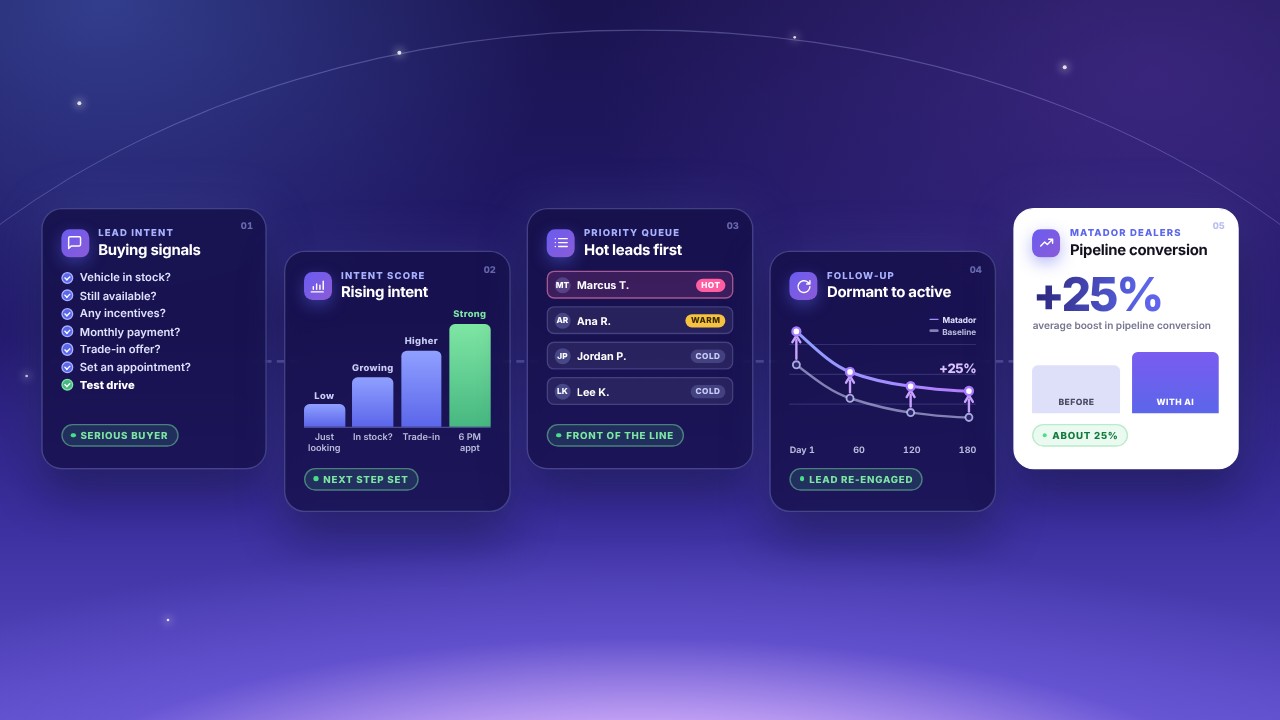
Every sales team knows there are tire kickers and just-lookers, then there are the more serious leads who are actually interested in a purchase. Your dealership regularly has to handle service bookings, test drives and questions about vehicle availability. An AI model can help keep track of everything, document who’s reached out and what they wanted, and can keep a record of previous interactions with every customer to track their context, emotional tone and motivation.
Use AI To Manage Simultaneous Conversations
When it seems like everyone’s coming at you at once…that’s when things can indeed get tricky, like trying to keep focused on one conversation in a noisy call center where everyone’s talking at the same time. When everyone’s busy with other tasks (or maybe dealing with walk-in customers), leave it to conversational AI to address incoming calls, answer common questions, book appointments and respond to messages.
Automate Follow-ups and Establish Clear Human Handoffs
Experience shows that often after-hours inquiries or peak hours questions get lost during the response and follow-up. A dealership AI system can keep those conversations alive by getting back to customers, then following your set of rules to route that conversation to the appropriate person when human expertise is needed.
Monitor Response Times and Missed Opportunities
Nobody likes being put on hold, nobody likes being handed off from one person to another while on the phone, and really nobody likes having to wait for an indefinite period to get an answer on something they need to find out. AI is a great way to handle that volume and track the essential measures like wait times, engagement rates, open questions and appointment booked.
Let’s run through a few typical scenarios and how AI can help your team handle them:
What happens when 10 customers contact your dealership at once?
Here’s the scenario: it’s a sunny Saturday, at 10:15 in the morning (usually peak hours for a dealership). Two of your sales team are on the lot with customers, another is with a customer on a test drive, people are stacked up at the drive-through for the service department and the BDC rep is unavailable. Suddenly, the lines light up with ten people at once.
This is where people typically get put on hold, wait hours for a callback or go to voicemail. Inevitably, some of them are going to give up and go somewhere else. Now let’s see how one of these calls would go with an AI agent to handle it:
- “Hi, I saw there’s a 2024 model Honda Pilot hybrid on your site, it looks pretty nice. Can we get together on a test drive today?”
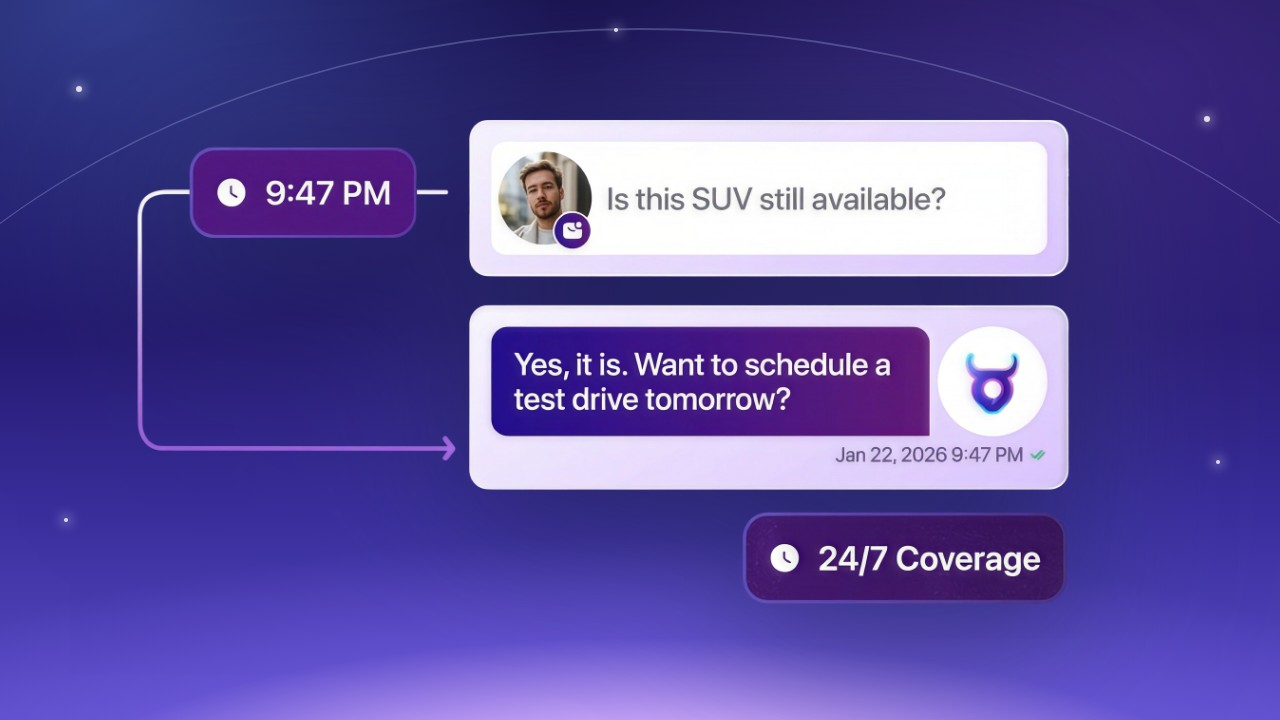
The AI agent gets the call on the first ring, confirms that the vehicle is still in the inventory, gives the customer a few options for a timeframe and books a test drive for 1:30 PM. The customer gets a text to confirm, along with the address and a reminder to not forget their driver’s license and proof of insurance. The appointment then goes into the CRM along with customer details, and the 1:30 appointment is assigned to a salesperson. Until the customer arrives, this process involves no employees. The AI also follows up with directions to the store before their appointment.
- “Hi, I can’t get in for my oil change appointment Tuesday at 9. Can we reschedule?”
The AI accesses the service department’s schedule and offers the customer slots for Thursday at 8 or Friday at 2:30. The customer picks a time and date, it’s recorded in the service department system and the Tuesday at 9 slot opens up for someone else. Again, no employees are engaged until the customer comes in.
Now, three shoppers at once:
- (chat) “I’m looking for an F150 for under $40k, do you have any in stock?” The AI accesses three matches from live inventory and shares links with the customer, including prices and mileage.
- (call) “Do you still have that nice white Civic Sport I was looking at?” The AI agent confirms that it’s still in inventory and was only listed four days previous, then offers an appointment to visit.
- (text) “I’m looking for a three row SUV with AWD” Since the query is a little vague, AI asks a followup question about budget, then offers a couple of vehicles and appointment times.
Again, no employees are involved at any point and no customer has to hear “let me put you on hold while I check and get an answer on that”. Two of them end up booking appointments.
Now let’s go to the website:
- “What are your hours on Sundays?” That’s a quick and easy answer from AI.
- “I have a ‘17 Explorer with 86k miles, do you take trade-ins?” The AI agent says yes and books an appointment for a trade-in appraisal.
No employees are involved, and the sales manager will get an update on the trade details in advance of the customer coming in.
Cold Leads and Follow-Ups
Three weeks ago, your dealership got a call from a customer about a Hyundai Santa Fe, and then the lead went cold. AI reached out to the customer and got the reply, “Still looking. Did the price change?”
The AI agent can then start the conversation again with the full history, including current price and availability, then asks if the customer would like an appointment. If the customer indicates they’re ready to talk pricing at the visit, the call is flagged as a hot lead and is routed to the salesperson who was the first contact, along with an update on the conversation. That salesperson is the only employee involved in this exchange, and is already up to speed when the customer comes in.
Now let’s think about two customers at once:
- “I’m interested in that Highlander for sure. Can you do $3k down and $480/month?”
- “My lease is wrapping up in two months. What are my best options?”
These are inquiries that need to be routed to an employee for judgment on lease strategies, pricing and financing. That’s outside the wheelhouse of AI, but the AI agent will take down that information and pass it on (in the form of a short summary) to the appropriate sales person.
So…all 10 customers got the answers they needed in seconds, seven of them were fully handled via AI and the three that came in for a visit met with salespeople who were already fully briefed.
AI doesn’t replace your team, but instead it takes the information and lays the groundwork for the conversations to come (the ones that close deals). Your staff can stay focused on the customers in the dealership, the ones at home get the service they need, and your team doesn’t end up frazzled and overwhelmed from handling a flood of 10 incoming contacts simultaneously.
How Matador AI Helps Dealerships Ride Herd on More Customer Conversations
Here’s the whole Matador AI suite:
- AI Engage: this is the first point of contact via email or text, engaging new leads
- AI Reply: when employees are busy, AI Reply takes over and keeps that conversation alive
- AI Follow-up: rather than let a lead stay cold, AI Follow-up reengages the customer and keeps the communication open
- Call AI: think of this as an AI receptionist, responding to incoming calls for service or sales
- Chat AI: forget about canned, preprogrammed website chatbots. Chat AI takes those conversations on website chat or supported channels and gives coherent, informed answers
These models are all designed to augment what your dealership’s employees already do, and helps to bring in more opportunities, cultivate more leads and book more appointments.
So there you have it – a comprehensive overview of what Matador’s AI for car dealerships can do to help your operations, complete with real-world scenarios. Why not book a demo and find out a little more?